Reviewed · HISTORICAL TOURS
Riga Jewish History Tour
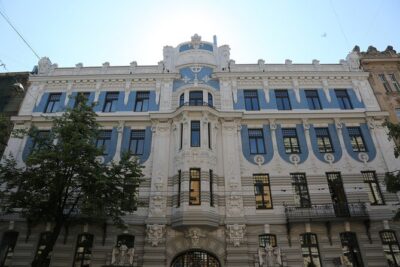
Riga’s Jewish story is written across its streets, forests, museums, and surviving places of worship. This private tour connects Art Nouveau buildings by Mikhail Eisenstein with the former ghetto, the Great Choral Synagogue memorial, Rumbula Forest, and the Peitavas Street Synagogue.
I like the private format, since you can ask questions without holding back and spend longer at a site if it matters to you. I also like the way the tour joins Jewish cultural life before the Second World War with the destruction that followed. The main consideration is emotional: the memorials and Holocaust sites make this a serious morning, not a light sightseeing outing.
Key points to know before you book
- Private transport keeps the morning moving: You travel between central Riga, the former ghetto area, Rumbula Forest, and the museum without arranging separate taxis.
- Art Nouveau gets a Jewish history angle: Mikhail Eisenstein designed several buildings, and philosopher Isaiah Berlin was born in one of them.
- Rumbula Forest is the longest stop: Plan for about an hour at the memorial to more than 25,000 people killed there in 1941.
- Guide Armands shapes the experience: He is available for questions, allows extra time when possible, and can adjust the route when some sites are closed for Shabbat.
- The synagogue visit has an extra cost: A donation is required on site, and the Holocaust Museum asks for a €5 donation per person.
- This suits a small private group: The tour is in English, begins at 9:00 a.m., and pickup is offered outside your hotel or apartment.
Riga’s Jewish story begins with Art Nouveau
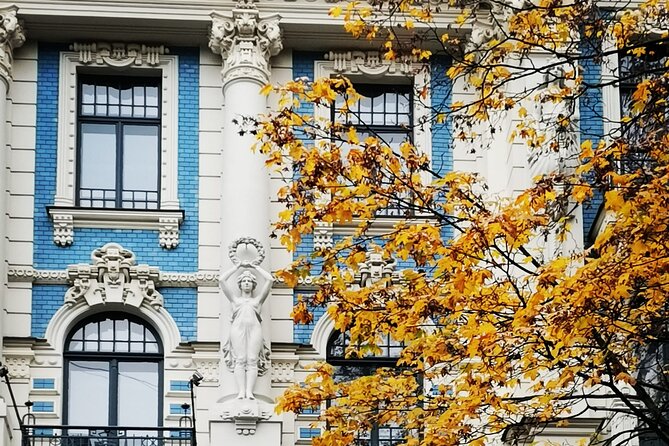
The tour opens in Riga’s Art Nouveau district, where handsome early 20th-century buildings take on a new meaning when you learn who designed them and who lived in the city. You spend about 30 minutes here, looking at the architecture while your guide explains its Jewish connections.
Several buildings in this area were designed by Mikhail Eisenstein, a Jewish architect whose work helps show the cultural contribution of Riga’s Jewish community before the war. One building is also connected with Isaiah Berlin, the philosopher who was born in Riga. That detail gives the opening stop a human scale: you are not simply looking at elaborate façades, but considering the people and ideas that formed part of the city’s prewar life.
I like beginning here because it avoids treating Jewish Riga as a story that starts only with persecution. The tour first presents achievement, urban life, architecture, and culture. That matters when you later visit places connected with the Holocaust.
Admission to the Art Nouveau stop is free. The visit is brief, so do not expect a full architecture tour. Instead, think of it as a focused introduction, with time for photographs and context before the tour turns toward the city’s more painful sites.
A few more Riga half-days to weigh up
- Cesis: Medieval Heritage and Natural Treasures
★ 4.0 · 4 reviews - Riga’s Architecture: A self-guided audio tour of the city’s art nouveau history
★ 5.0 · 3 reviews - All Inclusive Honest History Tour – Āraiši, Cēsis, Līgatne, Sigulda
★ 5.0 · 3 reviews
The Latgale Suburb and the former ghetto
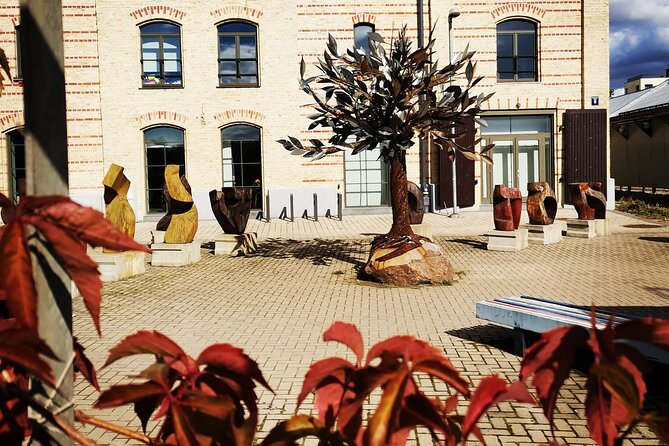
Next, you head to the Latgale Suburb, formerly part of the Riga Jewish Ghetto. The stop lasts about 30 minutes and focuses on the physical setting where the ghetto existed.
Many buildings here remain much as they were around 80 years ago, which can make the past feel unusually close. You are not being shown a reconstructed museum district. You are seeing an ordinary urban area whose streets and buildings carry the memory of the wartime period.
That also means the stop requires some imagination. The area does not offer a polished historical presentation at every turn, and the buildings themselves cannot explain what happened there. Armands’ narration is especially important here because he connects the visible streets with the history that is no longer obvious.
I would pay attention to the contrast between the everyday appearance of the neighborhood and the events associated with it. The former ghetto was not an isolated camp far from city life. It was part of Riga, and this stop helps you understand that geography.
The Great Choral Synagogue memorial
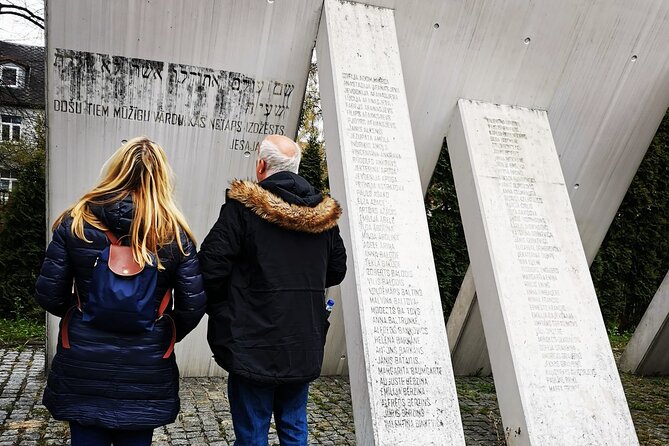
The next visit is short, about 15 minutes, but it carries a heavy weight. On July 4, 1941, more than 300 Jewish refugees from Lithuania and local Latvian Jews were forced into the basement of the Great Choral Synagogue. The synagogue was then intentionally burned.
Today, a memorial marks the site. You have time to stop, listen, and reflect rather than rush through another city address. The visit does not require an admission ticket, but its importance is not measured by how long you stay.
This is one place where the private format helps. You can ask Armands to clarify dates, people, or the wider setting, and you do not have to fit your response into a large group’s schedule. At the same time, the stop is not designed as a long museum visit. If you prefer extended time at memorials, say so during the tour.
Rumbula Forest, the tour’s quietest and longest stop
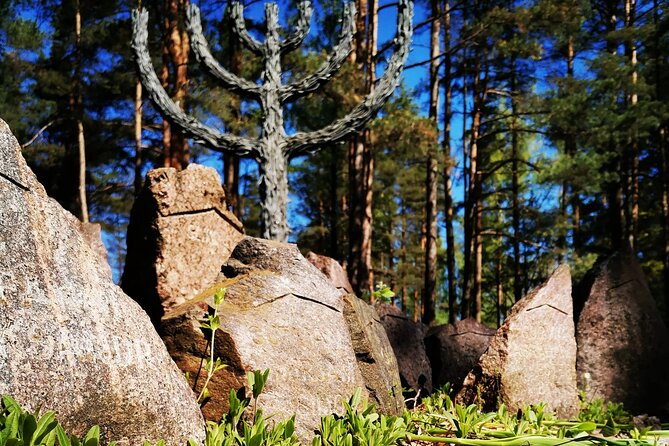
Rumbula Forest is the most time-consuming outdoor visit, with about an hour set aside for the memorial. In November and December 1941, the Nazis carried out the mass murder of the Riga ghetto’s Jewish prisoners here. More than 25,000 people were killed during the operations of November 30 and December 8, including about 1,000 Jews deported from Germany.
A complete memorial opened on November 29, 2002. The setting is different from the city stops, and that change in place gives the tour a pause from streets, façades, and buildings. You have room to walk, look, and consider the scale of the killings.
I would not treat this as a quick photo stop. The hour allocation tells you something useful: this is the point where you should slow down. The memorial deserves attention, and the wooded setting can make the visit feel private and solemn.
The tour description does not promise a guided walk through every part of the memorial, so your experience will depend partly on the conversation with Armands and how much time you choose to take. The private arrangement gives you more control than a fixed group schedule, but you should still prepare for a serious and quiet visit.
Out of the city, a completely different day:
- Riga Old Town walking tour
★ 4.5 · 304 reviews - Latvian food tasting tour at Riga Central market
★ 4.5 · 241 reviews - 2 countries! Hill of Crosses, Rundale Palace and Bauska castle
★ 5.0 · 225 reviews - Discover Riga Bike Tour
★ 5.0 · 166 reviews
The Riga Ghetto and Latvian Holocaust Museum
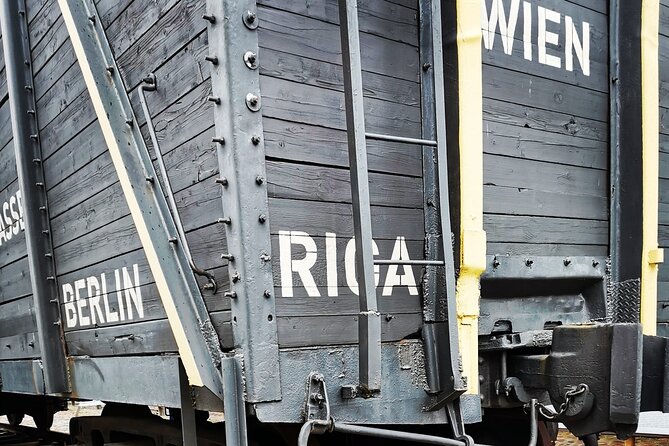
The Museum of Riga Ghetto and Holocaust in Latvia adds an indoor setting to the outdoor memorials. Its focus includes the story of the Riga Ghetto, the Holocaust in Latvia, and Jewish life in Latvia before the Holocaust.
That range is important. The museum is not only about the destruction. It also helps place Jewish life in Latvia before the war, giving you a fuller sense of what was lost. After seeing the former ghetto area and Rumbula Forest, an indoor museum can help organize the information and connect individual places with the larger story.
Allow about 30 minutes here. That is enough for a meaningful visit, but it may feel short if you read every display closely. You can purchase a book at the museum, which is useful if you want to continue learning after the tour.
There is a €5 donation per person for the museum, not included in the tour price. Bring this extra amount into your budget. The donation is modest, but the tour’s advertised price is not the final cost if you also visit the synagogue and give both requested contributions.
Peitavas Street Synagogue and Jewish life today
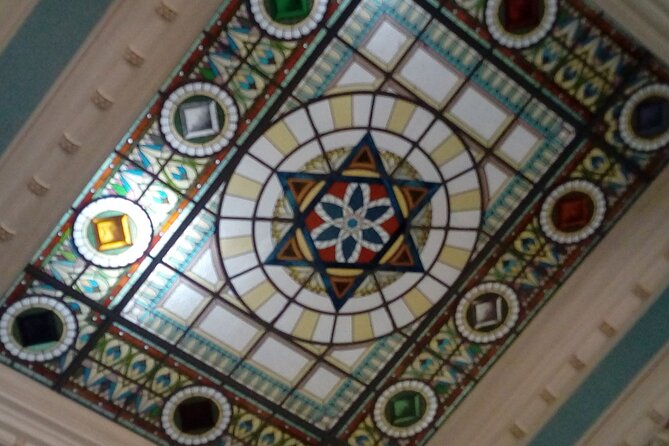
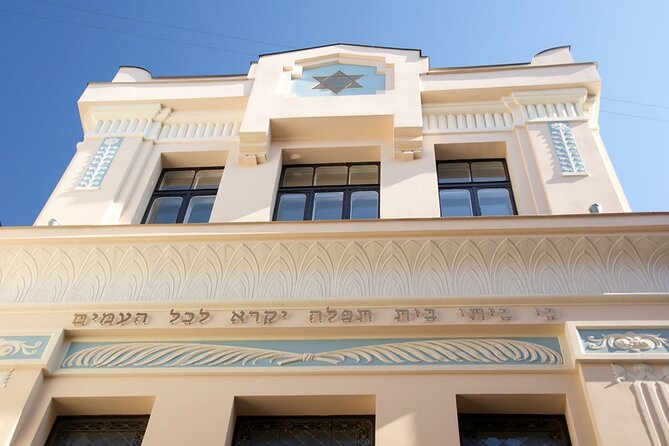
The final major stop is Riga Synagogue on Peitavas Street. Built between 1903 and 1905, it is an Art Nouveau building with Ancient Egyptian motifs and is regarded as an important cultural monument.
This visit changes the tone of the day. You have spent much of the tour looking at persecution and memorials, but the synagogue brings you back to Jewish religious life in Riga. Its architectural style also ties neatly to the opening stop in the Art Nouveau district.
A donation to the synagogue is required on site and is not included in the tour price. A kipa is provided if your head is not already covered by a cap, hat, or scarf. The stated visit lasts about 45 minutes, giving you more time here than at the Great Choral Synagogue memorial.
The schedule can change around Shabbat. On a Saturday booking, some places may be closed, and Armands has adjusted the route by taking visitors to another point of interest. That flexibility is useful, but I would still expect the exact order or content of the day to change if religious services or closures affect access.
Why the private format matters
The tour costs $96.33 per person and lasts roughly three to four hours. That is not a budget walking tour, but the price includes private transportation and guide services, which matter because the route covers central Riga, the former ghetto area, Rumbula Forest, and several separate sites.
You are paying for more than entry tickets. Most stops are free, and the museum and synagogue require donations rather than standard admission fees. The main value comes from having a vehicle, an English-speaking guide, and a private schedule for a route that would be awkward to piece together on foot.
I especially like the option to ask questions as you go. Armands has been praised for explaining subjects thoroughly, admitting when he does not know an answer, and spending extra time when a site deserves it. The tour may run longer than the original three to four hours if you linger, so avoid booking a tight next appointment.
Pickup is offered, but you should wait outside your hotel or apartment. The vehicle cannot park in Old Riga, so the pickup arrangement may require a short walk to an accessible meeting spot. The start time is 9:00 a.m., which gives you a full morning and leaves the afternoon open.
What to expect from the guide
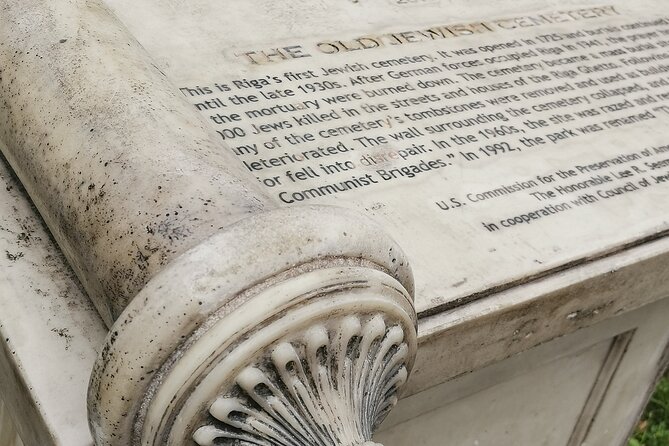
The guide is Armands, sometimes referred to as Armando in tour feedback. His role is central because some stops are places of memory rather than conventional attractions. You will rely on him to explain what is visible, what has changed, and what is no longer there.
The strongest part of his approach appears to be flexibility. He can give you time at each site rather than pushing you along at a fixed pace, and he has included extra places when appropriate. For a subject as personal as family history, that can be more useful than a rehearsed speech.
You should still take an active role. Bring your questions about Jewish life in Riga, the ghetto, the memorials, or the synagogue. Since this is a private activity, you can shape the conversation around your own interests.
The tour is offered in English. Confirmation arrives at booking, and most people can participate. The stated dress code is relaxed, with the usual requirement that you be dressed, and religious head covering is handled at the synagogue with a provided kipa when needed.
The emotional side of the morning
This is a Holocaust-focused tour, but it does not begin there. The opening look at Art Nouveau and Isaiah Berlin gives you a sense of Jewish cultural life before the war. From there, the route moves through confinement, murder, memorialization, and the surviving synagogue.
That progression makes the morning powerful, but it also demands attention. Rumbula Forest and the Great Choral Synagogue memorial are not casual sightseeing stops. You may find the day emotionally tiring, particularly if you have a family connection to the Holocaust or are visiting several memorial sites during a wider trip.
I appreciate that the tour presents the subject with tact and respect. It does not turn the memorials into entertainment. You have time to stand quietly, ask questions, and move at a reasonable pace.
Wear practical clothing and shoes suitable for walking at outdoor sites. No special dress is required, but the synagogue provides a kipa if your head is uncovered. The experience includes private transport, yet you should still expect to walk around the memorials and museum areas.
Who will get the most from this tour?
I would recommend this experience to anyone with a personal, family, academic, or cultural interest in Jewish Riga. It also suits you if you want to understand the city beyond its famous architecture and old-town streets.
The tour is a strong choice for a couple, family, or small group that prefers private conversation. It is particularly useful if you want the freedom to ask sensitive questions or spend extra time at a memorial without waiting for a large group.
It may be less suitable if you want a cheerful morning of sightseeing, a long architectural walk, or a museum-heavy itinerary. The Art Nouveau stop is brief, and the central subject is the Holocaust and its aftermath. You should also allow for the extra synagogue and museum donations.
The tour is often booked well ahead, with an average booking time of about 59 days in advance. That does not guarantee every date will sell out, but it is a good reason to arrange it early if your Riga schedule is fixed.
Cancellation and practical planning
You can cancel for a full refund up to 24 hours before the start time. Changes made less than 24 hours before the tour are not accepted, and the cut-off follows Riga’s local time.
Plan to begin outside your hotel or apartment at 9:00 a.m., since the car cannot park in Old Riga. Ask about the exact pickup point if you are staying inside the old town.
Budget for the €5 museum donation per person and the required synagogue donation. The tour price covers the guide and private transportation, but not those on-site contributions.
Should you book the Riga Jewish History Tour?
Book it if you want a serious, personal look at Riga’s Jewish past, especially if you value context over a simple checklist of sights. The mix of Art Nouveau, the former ghetto, Rumbula Forest, the Holocaust Museum, and Peitavas Street Synagogue gives the morning a clear historical arc.
I would choose this tour for private groups, family-history visitors, and anyone who wants to ask questions without a fixed group pace. Armands’ flexibility is another reason to book, particularly if your interests may lead to longer conversations or an extra stop.
Skip it if your time in Riga is too short for a three to four-hour history tour, or if you are not ready for the memorial sites’ subject matter. For the right visitor, the $96.33 price is fair because private transport solves the logistics and the guide connects places that would be difficult to understand on your own.
FAQ
How long does the Riga Jewish History Tour last?
The tour lasts approximately three to four hours. It may run longer if you spend extra time at the stops.
What time does the tour begin?
The stated start time is 9:00 a.m. Pickup is offered outside your hotel or apartment.
Is transportation included?
Yes. Private transportation and guide services are included in the tour price.
Is the tour private?
Yes. Only your group participates in the activity, and you can ask the guide questions throughout the tour.
Are donations included in the price?
No. A donation to the Peitavas Street Synagogue is required on site. The Riga Holocaust Museum also requests a €5 donation per person.
Is the tour offered in English?
Yes. The tour is offered in English.
Just added around Riga
- Group Tour: Sigulda and Turaida from Riga.★ 4.5 · 3 reviews
- Fun Walk Private Tour Around Central Market Riga★ 4.5 · 3 reviews
- Latvia’s Switzerland and Gauja National Park Tour★ 5.0 · 3 reviews
- Hiking Adventure in Gauja National Park – 7 Days★ 5.0 · 3 reviews
- Jurmala sunset tour★ 4.5 · 3 reviews
- Riga Private Walking Tour★ 5.0 · 4 reviews
- Full Day Gauja National Park Ultimate Hiking & Sightseeing Trip★ 5.0 · 4 reviews
- Private Snowmobile or ATV Safari with Riga Black Balsam Tasting★ 5.0 · 4 reviews
Historical Tours, compared.
All Inclusive Honest History Tour – Āraiši, Cēsis, Līgatne, Sigulda
Read our review →