
Reviewed · RIGA
Riga: Stories of Soviet Riga Guided Walking Tour
Riga’s Soviet past is not sealed away in a history book. It is written across the city in monuments, grand buildings, changed religious spaces, and memories that are still close to the surface. This two-hour walk connects those pieces, with guides such as Gunta explaining both the public story and what daily life felt like under Communist rule.
I like the personal angle, especially when a guide can explain how Soviet ideas affected Latvian culture rather than simply reciting dates. I also like the route’s mix of architecture and difficult history, from the Monument of the Latvian Rifleman to the Occupation Museum and deportation memorial. The main consideration is that this is a serious subject, not a light sightseeing stroll, and the tour does not include hotel pickup or museum admission.
Key points to know before you book
- Personal memories add weight: Guides including Gunta connect Latvia’s Soviet period to lived experience.
- Three important stops: The route focuses on the Occupation Museum, the Monument of the Latvian Rifleman, and the Deportation Memorial.
- Soviet and Art Nouveau together: You see how Riga’s older architecture existed alongside Soviet-era symbols and buildings.
- A compact two-hour walk: The tour fits neatly into a morning or afternoon, with the route ending where it begins.
- Small to medium group size: Tours run with at least two people and no more than 20 participants.
- Good practical setup: English and German tours are available, and a guide system is used when more than 10 people join.
Riga’s Soviet story begins in the Old Town
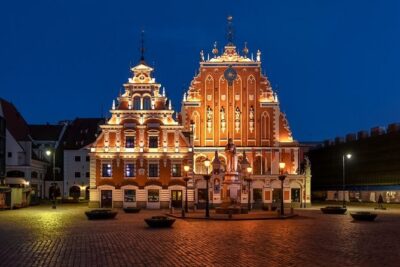
The meeting point is inside Rātslaukums, the square beside the House of the Blackheads. Look for a bicycle with a blue box and a yellow umbrella. The guide will be there, and the office entrance is behind the bike, on the left side of the House of the Blackheads museum doors.
This is a useful starting point because Riga’s Old Town can make the city seem entirely medieval or Hanseatic at first glance. The tour quickly broadens that picture. You begin in a historic center, then look at how Soviet power changed the meaning of public spaces, buildings, religion, and national identity.
I appreciate tours that start with a clear meeting point rather than a vague landmark. Rātslaukums is prominent, but the bicycle and yellow umbrella make the actual guide easier to spot. Arrive with a little time to spare, especially if you are unfamiliar with the square.
The tour is conducted in English or German. If the group grows beyond 10 people, a tour guide system is provided. That matters on city streets, where traffic and general noise can make a soft-spoken guide hard to follow.
More Soviet-era history walks:
- Private Soviet Riga tour
★ 5.0 · 8 reviews - Private Day Tour to Sigulda, Turaida Castle and Soviet Bunker
★ 4.5 · 8 reviews - Full-Day Private Trip to Nuclear Missile Base and Secret Soviet Bunker
★ 4.5 · 7 reviews
The Monument of the Latvian Rifleman and the politics of memory
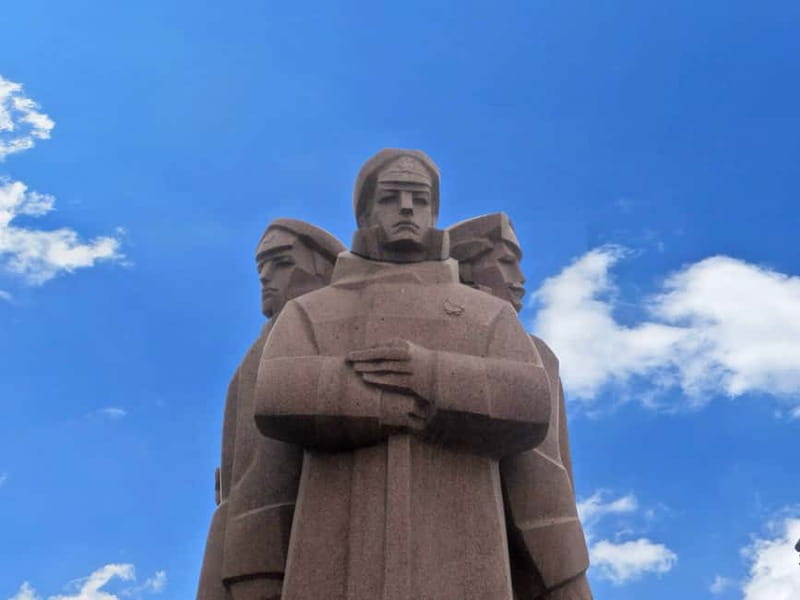
One of the central stops is the Monument of the Latvian Rifleman. It is not simply a statue to admire and photograph. The monument opens a discussion about how Soviet Riga presented the past, whose sacrifices were honored, and how symbols could be used to support a political message.
Latvia’s relationship with Soviet rule is complicated, and the monument helps show why. Public sculpture can preserve a version of history long after the government that commissioned it has disappeared. Your guide can explain how the monument fitted into the Soviet view of Latvia and how that view differed from Latvian national memory.
This is where a guide’s personal knowledge makes the greatest difference. A basic city walk might point out the monument and give you a date. This tour aims to explain how people were expected to think about such symbols and how those expectations affected Latvian culture.
Do not expect every stop to offer a simple good-versus-bad explanation. The value is in seeing how one place can carry different meanings at different times. That makes the stop useful for anyone interested in history, politics, monuments, or the way cities manage painful memories.
The Occupation Museum and the cost of political control
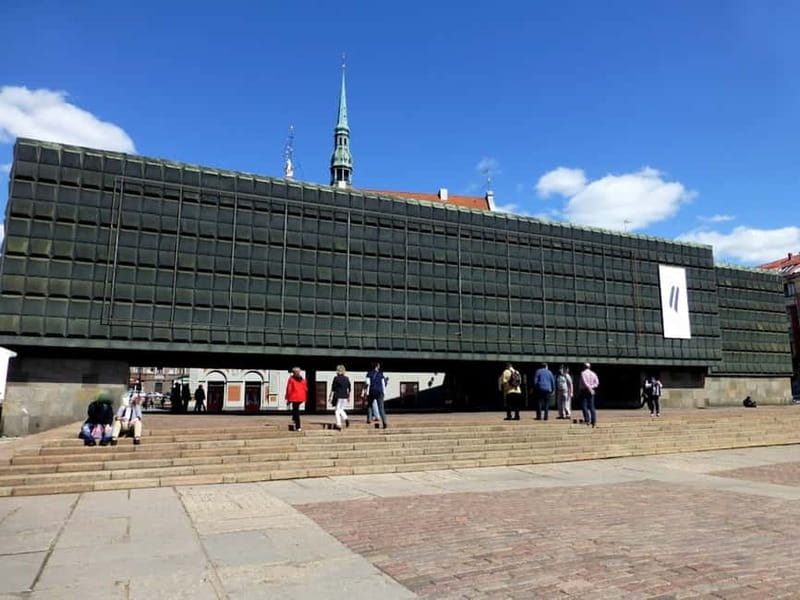
The Museum of the Occupation is another major point on the route. The tour’s stated focus is the museum as part of Riga’s Soviet story, but the walking tour itself does not list museum admission as included. You should therefore treat this as a guided exterior or surrounding-area stop unless your booking details say otherwise.
Even without entering, the museum gives the discussion a firm center. The subject is not only Soviet architecture. It is the effect of occupation and Communist rule on ordinary life, public speech, national culture, and memory. Your guide can place the building and its setting within that larger story.
I like this part of the tour because it keeps the history connected to Riga itself. You are not receiving a general lecture about the Soviet Union in a classroom. You are looking at a particular city and asking how its people, buildings, and public institutions changed.
If you want a full museum visit, plan separate time for it and check the museum’s own opening information. The two-hour walk is designed to introduce the subject through streets and landmarks, not to replace a museum visit.
The Deportation Memorial and the human side of the story
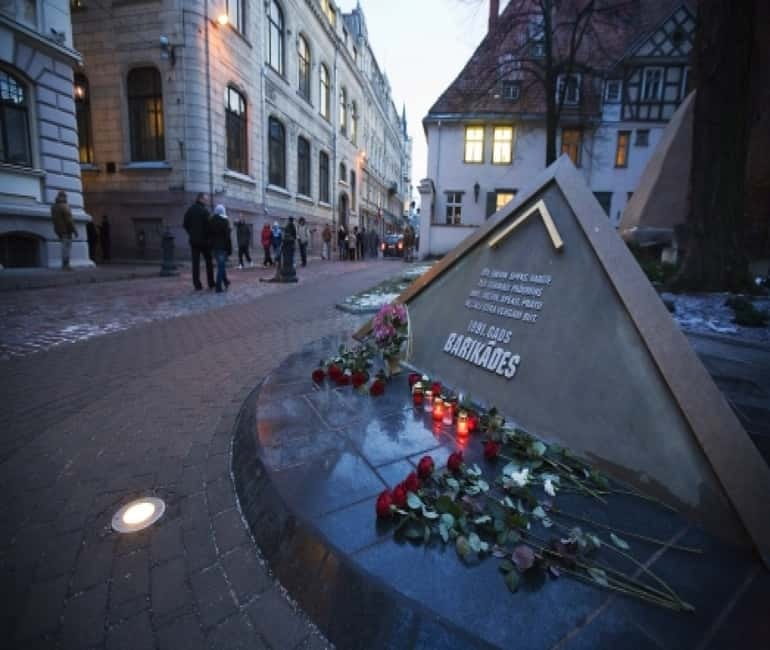
The Deportation Memorial brings the tour down from political symbols to the harm done to families. Its inclusion signals that this walk is not only about architecture or Cold War style. It also addresses the forced removal and suffering that shaped Latvian memory.
A stop like this can change the pace of the tour. Instead of looking up at a large monument or across a grand square, you are asked to consider individual lives and the lasting effects of state power. The guide’s explanation is especially important here because the meaning of a memorial may not be obvious from its physical design.
This is also the point where I would advise you to listen carefully and leave room for the subject’s seriousness. The tour is suitable for children according to the experience description, but parents should decide how much historical detail feels right for their family. The tone is respectful and educational, yet the topic includes sorrow and repression.
The memorial helps explain why Soviet Riga cannot be understood only through buildings. Architecture shows what a government wanted to project. Memorials show what people continue to remember.
More walking tours in Riga:
- Riga Old Town walking tour
★ 4.5 · 304 reviews - Best of Riga Walking Tour – Highlights and Hidden Gems
★ 5.0 · 147 reviews - Riga Old Town Walking Tour in a Small Group
★ 4.5 · 132 reviews - Private Riga Old Town Walking Tour
★ 5.0 · 62 reviews
Soviet buildings beside older Riga
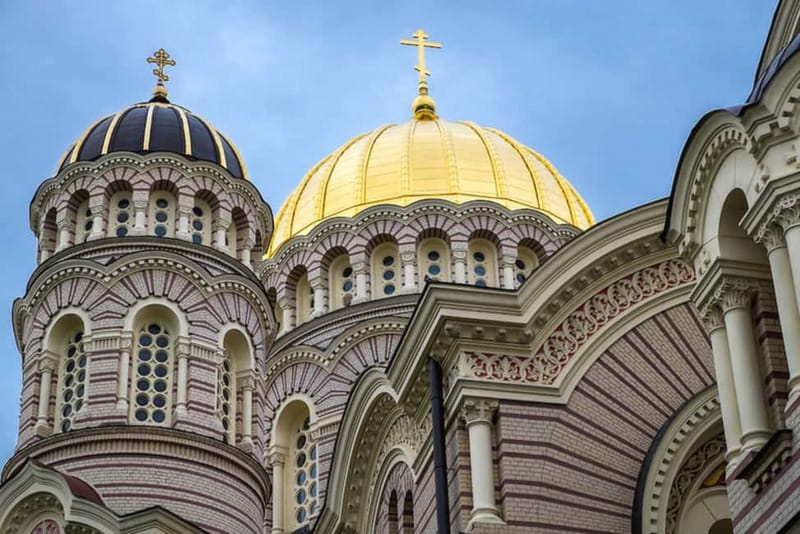
The walk also looks at the Academy of Sciences and the restored Cathedral of the Nativity of Christ. These buildings show two different sides of Riga’s changing identity.
The Academy of Sciences is linked to the grand, imposing style associated with Soviet public architecture. Its scale and formal design communicate authority. Even if you are not an architecture specialist, you can see how a building can make government feel physically present in the city.
The Cathedral of the Nativity of Christ offers a different story. During the Soviet period, it was used as a planetarium rather than as a functioning cathedral. Its later restoration reflects the return of religious and national symbols that had been suppressed or redirected.
That change is one of the tour’s most memorable architectural lessons. A building can survive while its purpose is altered. The cathedral’s history shows how Soviet policy affected not only monuments and government offices, but also faith and public culture.
The route’s blend of Soviet and Art Nouveau architecture adds another useful layer. Riga is famous for Art Nouveau, yet the city is not a single-period museum. Older styles, Soviet additions, restored religious buildings, and modern Latvian identity share the same streets. This contrast helps you read Riga as a living city rather than a collection of isolated sights.
What personal stories add to the walk
The guide’s memories are the feature I would value most. The tour promises private stories from people who lived under the Communist regime, and Gunta is specifically praised for bringing the period to life through personal experience.
Personal history does not replace documented history. It adds texture. A guide can explain what official language sounded like, how public life was shaped by Soviet ideas, or why a familiar building mattered to people who lived through the period. Those details often help you understand the emotional distance between the city’s polished present and its recent past.
You should also remember that personal memories are individual. One guide’s experience cannot represent every Latvian, every family, or every period of Soviet rule. The best way to use these stories is as a human entry point, then keep the wider political context in view.
That balance seems to be one of the tour’s strengths. The experience is not sold as a dry list of dates, and it is not presented as a purely personal memoir. It links private memory with visible places around Riga.
How the two-hour format works for your day
Two hours is long enough to give the subject shape without taking over your entire day. You can schedule the tour early in your Riga visit and use it to understand sights you may pass again later, or place it after a general Old Town walk for a more focused look at the recent past.
The tour starts and ends at the same meeting point. That makes planning simple. You do not need to arrange transport back to your hotel or work out where the guide will leave you.
There is no hotel pickup or drop-off, so you are responsible for reaching Rātslaukums. The experience is a walking tour, and the supplied information does not give a route distance or accessibility details. If you have mobility concerns, contact the provider before booking and ask about the current route.
Bring cash, as that is specifically listed among the things to bring. In bad weather, umbrellas are offered. Routes can change, so the exact order or streets used may vary.
The group minimum is two participants, with a maximum of 20. A group of 20 is not intimate, but it is still more manageable than a large coach tour. The guide system for groups of more than 10 should help keep explanations audible.
Is $45 a fair price for this Riga walking tour?
At $45 per person, this is not Riga’s cheapest city walk. The price covers a two-hour guided experience, a local guide, and the added audio system when needed. It does not include hotel transport or stated museum admission.
The value depends on what you want from the tour. If you only want to see major buildings from the outside, you could walk through central Riga on your own. If you want the political meaning of those places explained, especially through memories of life under Communism, the cost is easier to justify.
I would compare it with the price of a general city tour rather than with a museum ticket. You are paying for focus. The subject is narrow, but it is also one many first-time visitors miss while admiring Riga’s medieval center and Art Nouveau facades.
The strongest value comes from the guide. A flat route without a skilled explanation would not be worth as much. The repeated praise for Gunta’s history knowledge and personal experience suggests that guide quality can make a real difference, though guide assignment is not guaranteed.
Who will get the most from this experience?
I would recommend this tour to you if you want to understand Latvia beyond its attractive streets and historic center. It suits people interested in Soviet history, architecture, national identity, memorials, religion, and the way political systems shape ordinary life.
It can also work well for families with older children. The experience information specifically notes that it is good for kids, but the deportation and occupation subjects are serious. Parents should prepare children for a thoughtful history lesson rather than a playful sightseeing activity.
You may want to skip it if you prefer light tours focused on food, scenery, or decorative architecture. The mood includes happiness and sorrow, but the central subject is difficult. You will get more from it if you are willing to slow down and listen.
The tour is also a good choice if you have already seen Riga’s main medieval sights. It gives familiar places a second meaning and helps explain why the city feels culturally layered.
Booking, weather, and language details
You can book in English or German. The tour lasts two hours, but starting times depend on availability. It operates as a group experience, with at least two and no more than 20 participants.
You can cancel up to 24 hours before the start for a full refund. The reserve-now, pay-later option lets you hold a place without paying immediately, which is useful when your Riga schedule is still shifting.
Umbrellas are available in bad weather, but you should still wear practical walking shoes and clothing suited to the forecast. Alcohol and drugs are not allowed, and the tour asks you not to litter.
The meeting point details deserve one final reminder: find the blue-box bicycle with the yellow umbrella in Rātslaukums. The office is behind it, with the entrance on the left of the House of the Blackheads museum doors.
Should you book the Stories of Soviet Riga tour?
Book it if you want Riga’s recent past explained through real places and personal memories. The Occupation Museum, Latvian Rifleman monument, Deportation Memorial, Academy of Sciences, and former planetarium give the walk a clear structure, while guides such as Gunta add the human detail that a guidebook cannot provide.
At $45, it is best viewed as a focused history experience rather than a bargain sightseeing loop. Skip it if you want only cheerful Old Town highlights or a museum interior visit included in the ticket. For a thoughtful look at how Soviet rule changed Riga, this two-hour walk earns its place in your schedule.
FAQ
How long is the Stories of Soviet Riga tour?
The walking tour lasts two hours. Starting times depend on availability when you book.
Where does the tour begin?
It begins inside Rātslaukums. Look for a bicycle with a blue box and a yellow umbrella, where a guide will help you.
Where does the tour end?
The activity ends back at the meeting point in Rātslaukums.
Which languages are available?
Live tours are available in English and German.
What landmarks are included?
The tour highlights the Museum of the Occupation, the Monument of the Latvian Rifleman, and the Deportation Memorial. It also discusses the Academy of Sciences and the Cathedral of the Nativity of Christ.
Is museum admission included?
Museum admission is not listed among the included services. The included services are the walking tour, local guide, and a tour guide system for groups of more than 10.
How many people can join the group?
The group has a minimum of two participants and a maximum of 20.
Is a tour guide system provided?
Yes. A tour guide system is provided when more than 10 participants join.
Is hotel pickup included?
No. Hotel pickup and drop-off are not included.
What should I bring?
Cash is listed as something to bring. Umbrellas are offered in case of bad weather.
Just added around Riga
- Group Tour: Sigulda and Turaida from Riga.★ 4.5 · 3 reviews
- Latvia’s Switzerland and Gauja National Park Tour★ 5.0 · 3 reviews
- Fun Walk Private Tour Around Central Market Riga★ 4.5 · 3 reviews
- Hiking Adventure in Gauja National Park – 7 Days★ 5.0 · 3 reviews
- Jurmala sunset tour★ 4.5 · 3 reviews
- Riga Private Walking Tour★ 5.0 · 4 reviews
- Full Day Gauja National Park Ultimate Hiking & Sightseeing Trip★ 5.0 · 4 reviews
- Private Snowmobile or ATV Safari with Riga Black Balsam Tasting★ 5.0 · 4 reviews
Soviet History Tours, compared.
Private Day Tour to Sigulda, Turaida Castle and Soviet Bunker
Read our review →
Full-Day Private Trip to Nuclear Missile Base and Secret Soviet Bunker
Read our review →Browse the lists this tour appears in